The Stars of David Project
The Stars of David Project is a large-scale memorial installation in which six million hand-drawn Stars of David are used to honor the Jewish lives lost in the Holocaust, transforming a symbol once used to mark persecution into a collective act of remembrance.


The “Stars of David Project” offers a tribute to the six million Jewish victims of the Holocaust. Each hand-drawn, carefully placed star represents a life cut short by the Nazi regime. Between 1933 and 1945, the Jewish community of Europe lost two-thirds of its total population, changing the Jewish diaspora forever. The exhibit invites viewers to take a moment to remember the victims, including the documented stories we know and those that have been lost.
At the core of the project is a simple symbol: the Star of David—a symbol of Jewish identity, faith, and resilience. The star signifies our connection to the community and the lens through which we see the world. I use it as a building block, not just as a motif, but as a way to represent individual lives. The blue or darker Stars of David represent the vastness of loss, the weight of mourning. But slowly, sheet by sheet, a wave of yellow stars begins to emerge. It moves across the work like a current. These yellow stars are not just a reference to the badges Jews were forced to wear during the Holocaust. Here, they carry a different meaning. In this wave, each yellow star is a life we remember. They rise from the sea of blue as if to say, “I was here. I mattered.” They are the stories that call out to be known. These yellow stars shine as acts of remembrance. Each one is a whisper of a name, a memory pulled back from the void through our collective memory. The wave is not just symbolic of persecution; it’s also symbolic of presence. These are the lives we will not let disappear. The yellow does not mark shame here; it marks honor. It reclaims what was meant to dehumanize and makes it sacred instead. I hope that this work creates space: for reflection, for conversation, for connection, for future generations. It’s about memory, but also about the responsibility we have to tell the story. Because remembering isn’t passive, it’s something we do actively.
This project began in the spring of 2023 after learning that my 2nd great-grandmother died in the Holocaust at the Lodz Ghetto from starvation. I started thinking of the tremendous human toll of the Holocaust and the generational effect it has had on the Jewish community. A trip to Yad Vashem with my son cemented the Jewish idea that destroying a single life is to have destroyed an entire world. I began visualizing the universe, with so many stars that it is impossible to count or comprehend; this is how I wanted to show the impact of the Holocaust visually. The project took shape in the aftermath of October 7, 2023, and amid a resurgence of antisemitism worldwide. I saw the parallels of anti-semitism and blaming Jews for the world's issues. This strengthened my resolve to take on this massive project.
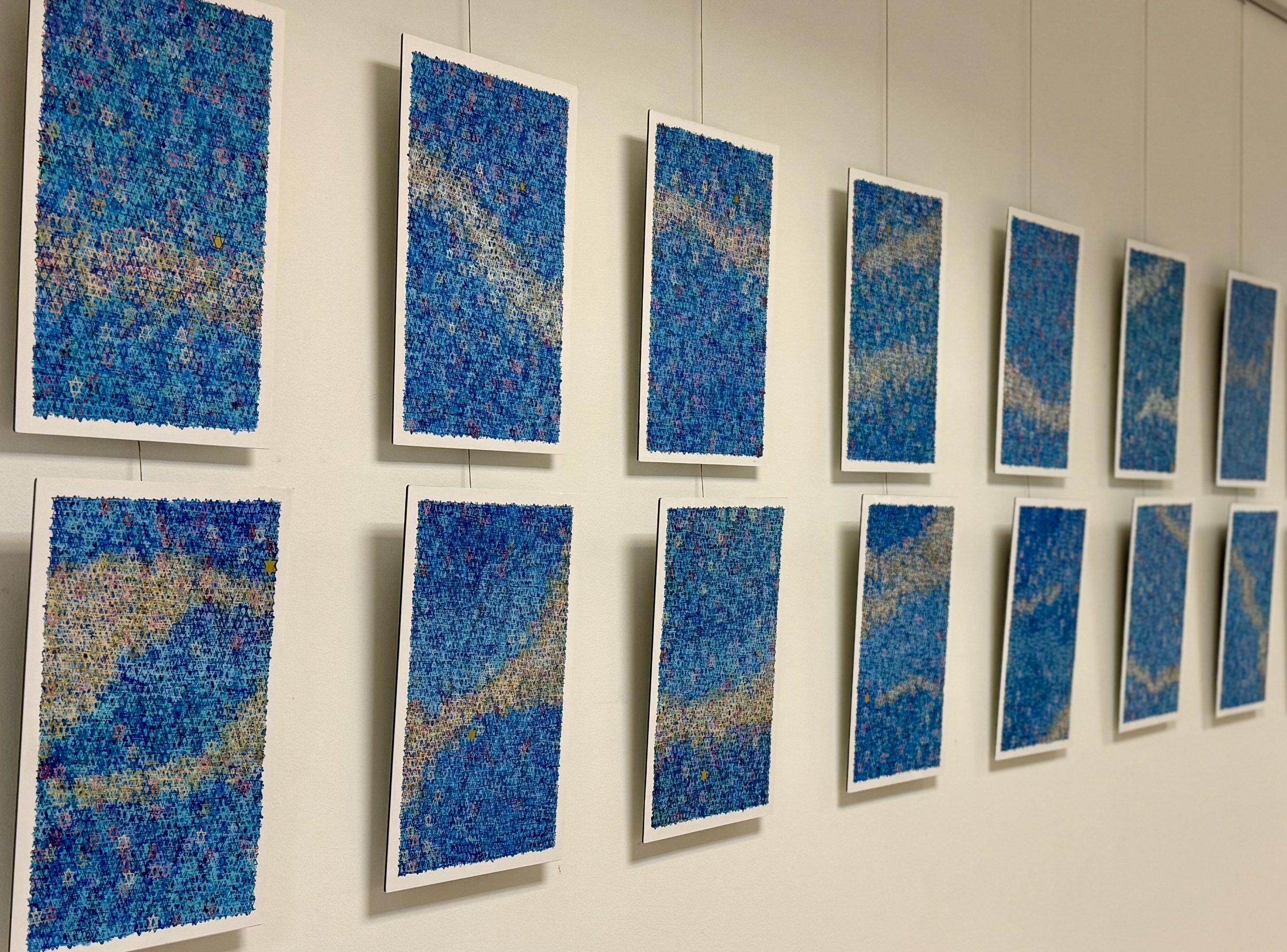
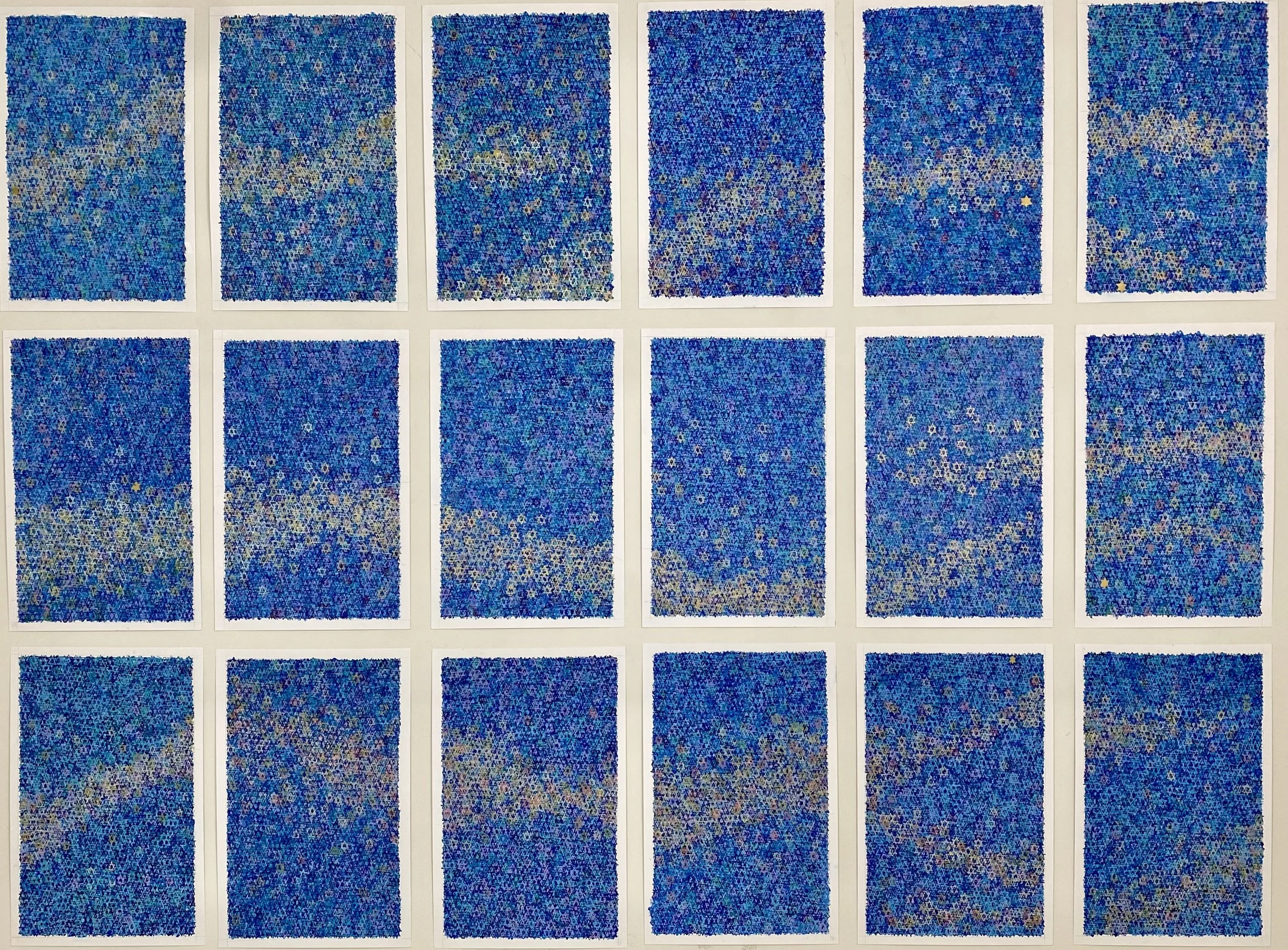
My process includes carefully drawing every star, remembering that each represents a life taken during the Shoah. Using paint pens on 11x17 sheets of Bristol board, I draw 20,000 Stars of David per sheet, meticulously counting each star and each life. I painstakingly count each star to ensure accuracy. Before beginning a new sheet, I say the Mourner’s Kaddish to remember the people who perished. The exhibit includes 300 11x17, totaling six million when exhibited together. The scale of this project is part of the message. When you see the sheets all together, the effect is overwhelming. And that’s intentional. I want people to feel the enormity of what was lost. The exhibit can be rearranged and displayed in several different ways, making it suitable for both small and large spaces.
For example:
All 300 pieces, representing the estimated 6 million Jews killed in the Holocaust.
40 pieces, representing the 800,000 Jews who died in the Ghettos from random shootings by the soldiers, lack of food, or rampant diseases.
50 pieces, the number of Jews who perished in WWII that were from the former Soviet Union, or the number of Jews who died in Auschwitz-Birkenau alone.
75 pieces, representing the 1,500,000 Jewish children who died in the holocaust.
100 pieces, representing the 2,000,000 Jewish men, women, and children who died from the mass shooting operation. The Germans and their allies and collaborators carried out mass shooting operations and related massacres of Jews in more than 1,500 cities, towns, and villages across occupied Eastern Europe.
135 pieces, representing the 2,700,000 that died in the killing centers. These killing centers were called Chełmno, Belzec, Sobibor, Treblinka, and Auschwitz-Birkenau
150 pieces, representing the 3 million Jews from Poland murdered throughout WW2 - 90% of the Polish Jewish community.
Scheduled Exhibits:
August - September 2026: Alpert Jewish Community Center, Long Beach, CA
January 2027: Evelyn Rubenstein Jewish Community Center of Houston, Houston, TX
Febuary 2027 - March 2027: Judi & Allan Schuman Museum Gallery, Levi JCC, Boca Raton, FL
April 2027 - May 2027: Midwest Center for Holocaust Education, Kansas City, KS
Past Exhibits:
2026
The Gallery Above the J at the Lewis JCC, West Nyack, NY
Athens Area Council for the Arts + The Arts Center, Athens, TN
The Jewish Community Center of Ann Arbor, MI
2025
Gordon Jewish Community Center, Nashville, TN
Chattanooga Jewish Cultural Center, Chattanooga, TN
Memphis Jewish Community Center, Shainberg Gallery, Memphis, TN


